
Linkin' and Thinkin'
Twenty things to read, and quick thoughts related to them

Dear Friends,
Here are some things worth reading and pondering this weekend, and quick comments by me on each.
Noah Smith, “Indians and Koreans not welcome.” In my view, the single dumbest immigration policy we could have would be one that shuts off the brain drain we have for the best and brightest to come here. Immigration is both an economic and cultural policy, and often there are trade-offs between the two. But not really with both H-1B and student visas. However else you might design the overall policy, I want to keep the part that attracts brilliant people here who stay and go on to start incredible Fortune 500 American businesses in northern California instead of wherever they originally came from. The Trump administration seems bent on turning that off as part of a culture war it is only tangentially related to.
Josh Barro, “Your Dislike of Charlie Kirk is Not Interesting Right Now.” I was stunned at the number of people who personally qualified their remorse about the Kirk assassination, or outright rejected stuff like the flags at half-mast. Josh very much captured the unsettling jumble of thoughts in my head. I do think one reason it’s worth publicly erring on the side of lionizing people like Kirk is that, on the margin, it probably discourages political violence if the end result is widespread adulation/appreciation for the assassinated.
Daniel Schuman and Chris Nehls, “The Quiet Shutdown Is Already Underway.” An excellent slightly-stepped-back review of the state of play vis a vis Trump administration encroachments on the congressional spending power, and here’s the companion piece about possible things Congress can do, including stuff that has nominal or significant bipartisan support. Unfortunately, the issue here isn’t really what Congress should do (though I appreciate Daniel and Chris laying it out), it’s what Congress can muster the votes to do. Constraining the executive on spending has rarely been a difficult literal question of how; we could draw up some killer limitation amendments in like 5 minutes that could be attached to the CR and would work wonders. The issue is the longstanding twin congressional problems of collective action and a short time horizon. Individual members simply don’t have the incentives to preserve institutional power when they conflict with substantive policy preferences supported by the president and their constituents. This is compounded by the lack of collective-action problem for the president, and shows up even in non-controversial legislation. For example, when substantive policy requires distributions of new authority, the president is always keen to make sure the legislation is written such that the power flows toward the executive, and individual Members of Congress rarely find reason to object.
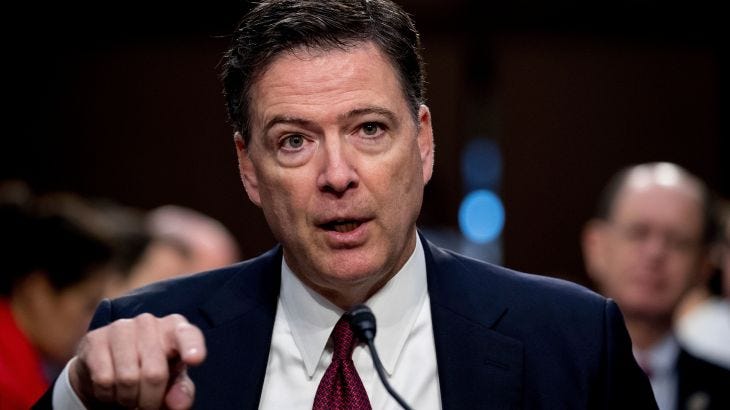
Jonathan Bernstein, “Trump’s Latest Crime Spree.” People who only casually follow politics—liberals and conservatives—always ask me “if I’m worried” because apparently I’m some sort of barometer for them, even if I’m not sure what they are asking. My answer hasn’t changed—there will be fair elections in America for the foreseeable future, and I’d lay big odds one or more Democrats will be in the White House before American ever collapses in a competitive authoritarian system. That doesn’t mean Trump isn’t giving me pause right now. His administration is morally pathetic (you can enforce tough immigration policies humanely, if you want) and corrosive to governing capacity and productivity (it’s so much easier to tear things down than to build), but none of that compares to his obvious wannabe-strongman approach. I don’t tend to call him an authoritarian, because it would give him too much credit, but his DOJ firings to bring an indictment against Comey are plainly impeachable abuses of power by the standards of both 1787 and 20th century practice and, along with the free speech nonsense, obvious moves drawn straight from any authoritarian playbook. The fact that this is barely registering with so many people is definitely nerve-racking.
Burgess Everett and Dave Weigel, “Tough Primaries Complicate Democrats’ bid to retake US Senate.” Liam Donovan sums it up well in a pithy tweet. For those who don’t remember, the Republicans threw away something like 5-10 Senate seats during the 2010s on a very simple formula: run a radical in a primary that defeats a great center-right candidate but has no chance of winning the general election. Prime examples of this template include Nevada 2010 (Angle over Lowden), Delaware 2010 (O’Donnell over Castle), Colorado 2010 (Buck over Norton), Indiana 2012 (Mourdock over Lugar), Missouri 2012 (Akin over the field), Alabama 2017 (Moore over Strange). Some of this has continued for the GOP in the 2020s (Herschel Walker, Dr. Oz, Blake Masters, etc.) But the news here is that the radical-primary-challenge disease may be spreading to the Dems. I can remember Tim Alberta predicting that this would eventually come to the Dems to me years ago, and I didn’t really quite see it. And it still doesn’t look as bad as it was for the GOP 15 years ago. But boy, it does not look good, either.
Scott Alexander, “Defining Defending Democracy: Contra The Election Winner Argument.” A basic defense of liberal democracy, and spot on. Elections alone can’t work unless you build in protections that ensure a fair future election, and that essentially leads you inevitably to the bill of rights and judicial review. I’d note that this is a case for what I think of as fundamental liberal democracy; you need individual rights of speech, press, association, due process, trial by jury, counsel, and against search and seizure in order to maximize the chances of the next election coming off. Beyond that you have what I think of as liberal suffrage (extending the franchise widely to unpropertied men, non-whites, women, etc.) and liberal lifestyle (freedom of religion, sexual preference, racial/gender civil rights), which aren’t necessary to the continued existence of a core democracy—the U.S. was a stable democracy for many years without much of them—but which many people (including myself) think of as essential to a modern liberal society, and without which many therefore-not-full-citizens just plain get screwed.
Julia Azari, “The President as partisan warrior.” See also this followup. Trump is far more likely than past presidents to wade into cultural conflict and apparently trivial issues. Julia notes a lot of seemingly-bizarre things Trump spends his time on—redecorating the White House, hosting the Kennedy Center Honors, beefing with individual colleges—that past presidents would have delegated or shied away from. But I think it’s even deeper than that. Trump really does spend a lot of time on what seem like truly trivial matters for a POTUS. Cracker Barrel logos. NFL kickoff rules. Sydney Sweeney ads. Some of this is supply-side; past presidents haven’t had social media and the associated capacity to micro-blog. But some of it also strikes me as borne of the grievance politics that defines so much of trumps cultural coalition, where ever perceived slight is more evidence of their status as victims. When Trump takes up Cracker Barrel, it’s not just a cultural signal about crumbling traditional America, it’s a reinforcement that things as small as restaurant logos are under attack by cultural opponents.
Andrew Sullivan, “The Woke Right Comes of Age.” I continue to be impressed by how much philosophical common-ground you can see amongst the populist right and the illiberal left. They hate each other, but that seems in some party just a difference of aesthetics and favored constituencies. The inverse of this, of course, is the way neither of those sides sees much difference between the various flavors of those firmly entrenched in the liberal tradition, be it Mitt Romney or Ezra Klein. The catch, of course, is that the illiberal left is a nuisance that influences politics; the populist right has captured a major party and currently runs the government.
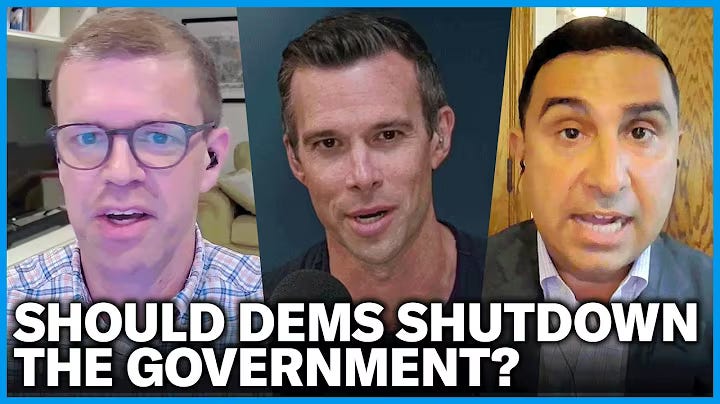
Matt Glassman and Faiz Shakir, “Should Dems Cause a Shutdown?” (youtube). Readers will be familiar with my case. Faiz comes at this from the attentional angle, and thinks thermostatically waiting for the 2026 election is not enough for Dems, who (in his view) need an articulated positive message to strongly counter the Trump administration. His case isn’t built on winning policy concessions in a shutdown—that’s good in my view, since you almost certainly won’t—but I think he very much overestimates both (a) the ability of any policy message to break through in the face of a shutdown that will almost inevitably be about, well, whether the government should be open; and (b) the ability of Democrats to message in any coherent fashion, and particularly relative to what will almost certainly be a simple, unified GOP message.
Sean Westwood, “America’s response to Kirk Assassination.” (Poll). See associated tweet here. Basically nobody (less than 1%) in either party will support partisan murders. Unfortunately, there are millions of people (and just as many bots) on social media, so it’s not at all hard to find a couple hundred real or fake idiots condoning basically anything. This dynamic—where partisans nutpick the most outrageous opinions of the other side and elevate their status—wasn’t invented by social media, but it is absolutely turbocharged by it.
Reid Epstein, “A New Democratic Think Tank Wants to Curb the Influence of Liberal Groups.” A rollout piece for the Searchlight Institute, a centrist policy shop started by Adam Jentleson, a former Harry Reid and John Fetterman guy in the Senate. In some ways, the entire project is a continuation of the Dem strategic fight over “moderation.” Should the party aim to be a progressive majority, or should it try to win back center and just-right-of-center voters by giving up on some of the loser progressive positions and tacking a new course? On the other hand, Searchlight represents an institutional response to the perceived problems of “the groups,” the various issue-specific activist outposts that elected Dems find themselves beholden to and that tend to demand attention and also bleed across issues in annoying ways, because of their unwillingness to compromise. And so candidates feel the need to take a stance on niche issues like transgender prisoner surgeries, and housing policy becomes ensnared by environmental policy.
Lee Drutman, “How Democrats Could Win a Shutdown, and Why They Won’t.” Not really about shutdowns, but more about a theory of strategic conflict, and a Schattschneider-like view about altering how current political conflicts are understood. In some ways, this piece misses the biggest point in has in its favor, perhaps because the Republicans grabbed it: the opening 10 year ago to shift the dimension of conflict on to a populist/cosmopolitan dimension centered around immigration. As was vaguely-known at the time but now has become world-wide obvious, left and right parties across the globe essentially all stood to the left of national populations on immigration 15 years ago, and the rise of right populists can be pretty dryly explained by them simply exploiting the market failure for rightwing immigration parties. Note that this same story is often told about the rise of the anti-slavery Republican party in the 1850s. Is there a similar market failure right now that could be grabbed by Democrats? Unclear, as these things usually are until they are retrospectives. But it’s a better way to think about political conflict and strategic party ideology than simply offering alternatives on your opponents conflict turf.
Nate Silver, “The political mood feels like 9/11 again.” I agree. Silver posits that the post-9/11 atmosphere had a specific effect on people roughly his and my age (late GenX). Also agree, but in my view the more important feature was how jarring it all was compared to the 90s for folks my age. I was a kid (11) when the Berlin Wall came down and an adult (23) on 9/11, so my entire formative period took place in that bizarre interregnum between the Cold War and the War on Terror, where everything looked like it was going to be great, the world seemed like it was heading inexorably in the right direction, America was going to be the leader, liberalism was going to rule the world, and the things you fought over was stuff like “What should we do with this budget surplus?” and “Should a scumbag president be impeached for getting a blowjob?” In some ways, I feel like I’m still waiting for the world to revert to that normal. I know it won’t—it’s quite obviously the opposite of normal, unfortunately—but I still think it very much colors how people my age understand politics.
Ezra Klein, “Trump is Building the Blue Scare.” An interview with Corey Robin, who is an excellent political scientist and historian. Robin says that he got his assessment of Trump wrong in his first term, but I don’t think that’s quite right. Trump is, in some ways, a completely different political figure in his second term than his first, both in policies and style. And I’m haunted by what a comparative politics scholar said to me in 2017. “The real problems start after the first reelection. That’s when would-be authoritarians show their colors.” I’m still disinclined to see Trump as having much chance of building an authoritarian state, but even having the conversation seriously is remarkable, and a reminder how easy it is to topple liberal democracies much less and embedded than the United States. That many comparative politics types—armchair or trained—tend to select on the dependent variable rather than look at would-like-to-be-strongman is only so comforting.
William Howell and Terry Moe, “Trajectory of Power: The Rise of the Strongman Presidency” (book). Substack article by the authors here. An argument in some ways for the inevitability of the crisis of runaway presidential power. Every modern government needs an administrative state, and creating one necessarily entails a strong executive, and that will necessarily lead you to ever-increasing aggrandizement. The authors see a partisan twist in all this, due to how Republicans and Democrats differently view the administrative state, but I see a lot more 18th century history. That American democracy arose just prior to the conviction that actual parliamentary systems could create stable governments led us to freeze a very 18th century system in place, including a king-like figure as executive. The parliamentary systems have their own problems of legislative control, but seem to have mostly retained existential legislative supremacy, in the form of parties easily being able to dump leaders and citizens not attaching plebiscitary power to prime ministers. Leaving England just prior to her completion of the transition to full parliamentary sovereignty may be biting us in the ass a quarter-millennium later.
Richard Hanania, “Power is Power.” I agree with Richard that contemporary right-wing cancel culture feels much more dangerous, because it is top-down and seems to have government power potentially backing it, but the left-wing bottom-up cancel culture of five years ago felt more stifling, because it seemed to much better permeate the institutions of civil society more thoroughly. Richard is also spot on that arguments about “which is worse” are silly when you are comparing two largely different bad things which really need to be addressed independently. And, relatedly, if you catch yourself using the construction “Well, [bad thing X] being done [people I like] is ok because [bad thing Y] was done by [people I don’t like] and wasn’t sufficiently derided by [people I don’t like],” you probably should reassess.
Gabe Fleischer, “Inside the Gen Z Media Ecosystem.” I have reached the uncomfortable age where I (a) no longer feel compelled to keep up with brand new technology, but also (b) no longer feel bad about it. If you are GenX or a boomer and you follow politics closely, you will probably feel as dumb I as did reading Gabe’s short guide to the political personalities who dominate the apps the kids are using. I recognized maybe half the names. Also, subscribe to Gabe’s substack, his daily newsletter is phenomenal.
Eliezer Yudkowski and Nate Soares, If Anyone Builds It, Everybody Dies (book). Two renown AI experts and leading misalignment doomers lay out their case against building AGI/ASI. Their discussion of complete computer security as a fundamental impossibility in the face of determined and clever hackers has direct parallels to democratic politics; just as no computer code/architecture can guarantee impenetrability because it would require the coder to consider all possible novel attacks, no law can written so tightly as to constrain expansive executive readings, because it would require consideration of all possible workarounds. We can partially patch it by designing systems that incentivize compliant good-faith executive behavior and properly punishing bad-faith misbehavior. This can take any number of forms, but essentially relies on actionable legislative supremacy more than constitutional or statutory prior restraint.

Judge Glock, “Biden’s Progressive Infrastructure Boondoggle.” Ignore any partisan inflections in this piece—we’re talking about the bipartisan infrastructure law, after all—and just look at the substance. It’s more evidence that the core government question of our time is capacity to, well, do anything. It has been such a longstanding trope in America that government projects are wasteful and inefficient that you can forgive people for not realizing it’s not always like that in other countries and at other times in American history. The abundance crowd right now is still largely a nascent bunch of neoliberal dads talking with Jennifer Palhka, but that doesn’t mean they are wrong.
Daniel Zawodny, “Between Boon and Boondoggle, the Purple Line Winds Toward Completion.” Case and point right here in DC. Nothing seems to impress Americans more than European and Asian public transportation systems. I have no idea if they are actually great, or if we are just comparing everything to the DC Metro.
Cheers,
Matt